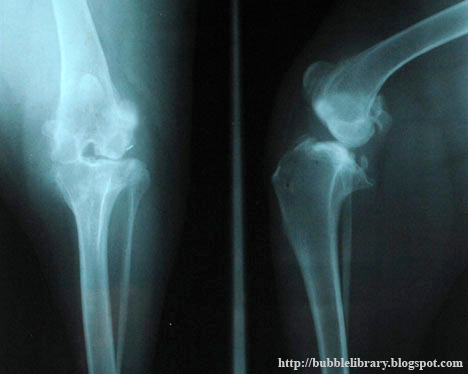
Bones - we have bones to give us shape and support the body, to protect and contain the body's delicate vital organs, and to help us move about. Bones are made from living tissue, composed of special cells which secrete around themselves hard material rich in
calcium salts. In a child the bones are soft and cartilaginous (Cartilage is gristle, the elastic substance of the ear or nose). Bone making, or ossification, is a gradual process. A baby has as many as 270 bones, but an adult only 206, for some bones grow together as they get older. All bones have a middle cavity filled with a yellow or red fatty substance called bone marrow, the blood making factory of the body, which also keeps bones light without reducing their strength. The basic part of the skeleton is the spine, which has 33 bones or vertebrae. The spine carries the weight of the body, is extremely flexible and contains and protects the delicate spinal cord. The skull shelters the brain while the ribs protect the heart and lungs. Bones fit together at the joints and are held firm by ligaments, which are made of tough tissue like cords or straps. Inside each joint is a thin membraneous bag which secretes a lubricant to make the joint move smoothly. Some glide on one another, as the lower jaw slides on the upper. Some, such as the elbow and the knee, hinge on each other and others, like the hip, make a ball and socket joint. Bones are sometimes fused together and immovable, as in the five large, lower vertebrae called the sacrum.
| Alertpay ☻ Maynilad ☻ Meralco ☻ Make Money Blogging ☻ Paypal ☻ Philhealth ☻ Pldt |
|
Showing posts with label Bones. Show all posts
When do bones break?
Broken bones - bones break under varying degrees of pressure according to age, health and other circumstances. They are made of hard, strong connective tissue and normally resist considerable force before breaking or fracturing. But when a bone has been softened by disease or grown fragile with age, fractures may follow very minor accidents or even occur spontaneously (pathological fractures). The bones of children are not fully mature and are still relatively flexible. In childhood a severe blow or fall often results in a (greenstick) fracture, in which the bone appears to bend but does not completely break into two separate pieces. An impacted fracture occurs when the broken ends of the bone appear to be jammed together by the force of the injury. A comminuted fracture is one in which the ends are shatted into many pieces. A fracture is called simple (closed) when the overlying skin is not broken, or compound (open) when the bone is exposed. All fractures attempts to heal themselves by producing new tissue to join the broken pieces together. At first this tissue is like putty and easily injured. So, generally a fractured limb should be straightened, immobilized and protected by a plaster cast while the healing takes place. In time the new tissue, or fracture callus, changes into mature bone.
Subscribe to:
Posts (Atom)